




The best colostrum powder: our buying answer before the marketing
Roundway is the clearest pure colostrum option in the current TBS catalog for UK shoppers. Its powder is a single ingredient, the company identifies it as freeze-dried bovine colostrum from grass-fed cows, and the UK purchase route is straightforward. Its main limitation is equally important: the product page does not prominently state a standardized immunoglobulin G percentage or enough dosing detail to calculate value per gram from the page alone.
Chuga is the more practical US purchase, but it is not a pure colostrum powder. Each 4-gram serving contains 1 gram of whole bovine colostrum and 3 grams of bovine collagen peptides. That fixed 3:1 ratio suits someone intentionally shopping for both ingredients. It is a weak fit for a buyer who wants to adjust colostrum independently or compare a larger colostrum dose.
- Best pure UK option: Roundway Bovine Colostrum Powder.
- Best US blend: Chuga Grass-Fed Colostrum + Collagen Peptides.
- Best for a disclosed standardized IgG target: neither product provides enough prominent current information to earn that position.
No clinical trial establishes either branded product as the best for gut, immune, athletic, or skin outcomes. This ranking is based on formulation transparency, purchasing practicality, and value, not on unverified promises.
Commercial information was checked on September 4, 2026. Prices and availability may change.
What bovine colostrum powder actually is
Colostrum is the early milk produced after a cow gives birth. It contains proteins, immunoglobulins, growth factors, and other bioactive components. Processing turns this perishable material into a shelf-stable powder, but the finished products sold online are not interchangeable. Collection timing, heat exposure, filtration, drying, source herd, added ingredients, and storage can all affect what reaches the scoop.
Terms such as first milking, six-hour, grass-fed, pasture-raised, low-temperature, or freeze-dried can help describe sourcing and processing. They do not prove a clinical result on their own. A buyer should look for a specific statement, current product documentation, and test evidence rather than assuming that pastoral imagery establishes quality.
Pure colostrum and blends belong in different comparisons
A single-ingredient product lets you see how much powder is colostrum. A blend may show a large scoop while delivering only a fraction of that amount as colostrum. The front of Chuga's package could reasonably attract a colostrum shopper, but the Supplement Facts reveal that three quarters of the serving by weight is collagen peptides.
That does not make a blend deceptive or inferior when the label is clear. It changes the buying question. Someone who already uses collagen may prefer one container. Someone researching a colostrum dose used in a study needs to know that 4 grams of the Chuga blend is not 4 grams of colostrum. Never compare products by scoop weight until you separate each active ingredient.
The five label details that matter most
1. Colostrum per full serving
Find the grams of actual bovine colostrum, not the total powder or proprietary blend. If the brand does not state it, you cannot make a valid price-per-gram comparison. Also check how many servings the container offers at the exact dose you intend to use.
2. Immunoglobulin standardization
Immunoglobulin G, usually shortened to IgG, is often used as a compositional marker. A percentage can help buyers compare lots or products, but it is not a universal score of human benefit. Ask whether the percentage is guaranteed in the finished powder, how it is measured, and whether the current lot report supports the claim.
3. Heat and drying information
Freeze-dried or low-temperature language can indicate an effort to preserve heat-sensitive constituents. It still needs context. Food-safety controls, pasteurization, moisture, microbial specifications, and finished-batch testing matter alongside a gentle-processing claim.
4. Herd and collection details
Grass-fed and early collection can inform preference and traceability, but definitions vary. Look for origin, collection window, animal-welfare standard, and a clear statement that calves receive priority where the brand makes an ethical claim.
5. Allergens and added ingredients
Bovine colostrum is a milk-derived ingredient. In the United States, milk is a major food allergen, and FDA industry guidance specifically identifies bovine colostrum as an ingredient that should declare milk. A dairy origin also matters to people who are vegan, have a milk allergy, or avoid dairy for another reason. Lactose content can vary, so a general low-lactose claim is not enough for someone with a clinically important restriction.
How to calculate value without fooling yourself
Begin with the delivered price, not the crossed-out price. Divide by the number of complete servings for cost per day. Then divide the delivered price by total grams of colostrum in the container for cost per gram. If the product combines colostrum with collagen, subtracting the collagen is not possible financially, but separating the ingredient weights prevents an inflated scoop from looking like a larger colostrum dose.
A subscription can reduce the first displayed price while creating recurring orders. Compare the renewal amount, frequency, minimum commitment, cancellation window, shipping, tax, and refund exclusions. A generous satisfaction guarantee is useful only if its formal terms support the headline.

Roundway and Chuga compared
Roundway Bovine Colostrum Powder: best pure UK option
Roundway Bovine Colostrum Powder is a single-ingredient product made with freeze-dried bovine colostrum. The company describes its source as grass-fed cows and states that the product is manufactured in the United Kingdom under GMP standards. It contains milk and has no added flavor or sweetener listed on the official page.
The official product page displayed £19.99 for 30 servings. That is about £0.67 per labeled serving before delivery. The page did not prominently state the gram weight of that daily serving in the information we reviewed, so a responsible buyer cannot compare its price per gram of colostrum without checking the current pouch label or asking the company.
Roundway's shipping page lists Royal Mail Tracked 48 at £2.99, free UK delivery over £50, and same-day dispatch for qualifying orders before 3 p.m. The storefront presented a UK purchasing route; we did not confirm routine US delivery, so American readers should not assume the pound price is available to them.
The product page advertises a 60-day guarantee, while the company's formal refund policy describes a 14-day cancellation period, acceptable-condition requirements, customer-paid return shipping, and nonrefundable original shipping. Because those statements are not identical, confirm the terms that apply to an opened supplement before ordering.
Best for: UK buyers who want a pure, unflavored colostrum powder and are willing to verify the serving weight and current batch documentation.
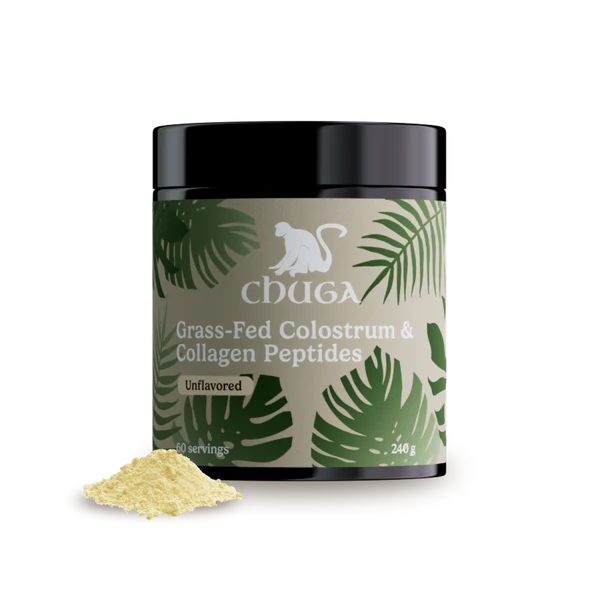
Chuga Grass-Fed Colostrum + Collagen: best US blend
Chuga Grass-Fed Colostrum is sold as a 240-gram tub with 60 servings. Each 4-gram serving provides 1 gram of bovine whole colostrum and 3 grams of bovine collagen peptides. The container therefore supplies 60 grams of colostrum and 180 grams of collagen, assuming the label values across all 60 servings.
The official Chuga page displayed $59 and in-stock status. That equals about $0.98 per serving and about $0.98 per gram of colostrum before shipping and tax. Chuga describes the colostrum as grass-fed and collected in the first four to six hours. The page did not present a standardized finished-product IgG percentage in the label information we reviewed.
Chuga states that it processes orders in one to two business days, estimates four to seven business days for domestic delivery, and offers free US shipping over $75. International shipping is free over $125 and is estimated at two to three weeks, but destination acceptance, duties, and local rules still need to be checked at checkout.
The company advertises a 45-day money-back period measured from receipt. Buyers should retain the container and order information and review the current instructions before returning anything. A refund policy reduces purchase risk; it does not validate claims about immune, gut, beauty, or performance outcomes.
Best for: US buyers who intentionally want a collagen-dominant combination and accept that the colostrum cannot be dosed independently.
What the science can and cannot support
Human research on bovine colostrum is interesting but not decisive enough to turn a product page into a treatment claim. A 2024 meta-analysis of intestinal permeability outcomes included 10 articles and found improvements in some measures, but results were highly heterogeneous for at least one major outcome. The authors called for additional trials.
A separate 2024 systematic review of gastrointestinal disease included 22 trials and 1,427 participants. It reported potentially beneficial findings in some settings but concluded that the evidence remained limited and that more controlled trials were needed. Study populations, health conditions, products, and doses differed.
For exercising adults, a systematic review and meta-analysis of upper respiratory tract infection outcomes included five trials and 152 participants. Four of the five studies had moderate or high risk of bias, and precision was limited. A later sport-focused review found that evidence for performance and body-composition benefits was limited, while gut-barrier and illness findings were more promising but still affected by differences in dose and product bioactivity.
These studies do not prove that Chuga's 1-gram colostrum portion or Roundway's current finished powder will reproduce a particular result. A branded product needs its own formulation, dose, quality, and population to match the research before a specific outcome can be inferred.
Testing questions worth sending to a brand
- What is the actual bovine colostrum weight per serving and per container?
- Is IgG standardized in the finished product, and what method measures it?
- Can you provide a certificate of analysis for the lot currently shipping?
- Which microbial, heavy-metal, identity, and moisture tests are performed?
- Where is the colostrum collected, and how soon after calving?
- What pasteurization, filtration, and drying steps are used?
- How is calf welfare protected, and is surplus collection documented?
- What are the milk-allergen, lactose, storage, and contamination controls?
A useful certificate identifies the product, lot, laboratory, test date, method, analyte, result, unit, and specification. A generic tested badge or a report with no matching lot is less informative.
Who should avoid or discuss colostrum first?
Anyone with a milk allergy should avoid bovine colostrum unless a qualified allergy professional gives different individualized advice. Lactose intolerance is not the same as milk-protein allergy, but it can still affect tolerability depending on the product. The presence of collagen adds another animal-derived ingredient to Chuga, so neither product is vegetarian or vegan.
Pregnant or breastfeeding people, children, individuals with a medically managed condition, and those taking prescription medicines should discuss use with a qualified clinician. People receiving cancer treatment, immunosuppressive therapy, or care for an immune or gastrointestinal disorder should not replace established treatment with a supplement.
Stop use and seek appropriate care for signs of an allergic reaction. Digestive symptoms after a dairy-derived powder should not be dismissed as proof that the product is working.
Our verdict
Roundway is the better match for a UK shopper seeking pure bovine colostrum with no flavoring or added sweetener. Its price per labeled serving is clear, but its page needs better disclosure of serving grams and standardized IgG before a stronger composition ranking is possible.
Chuga is the better current purchase route for a US shopper who specifically wants collagen with colostrum. At $59, the buyer receives 60 grams of colostrum across the tub, not 240 grams. That distinction should drive both dose and value comparisons.
Neither wins for clinical superiority, and neither should be purchased on the strength of fast gut, immunity, recovery, or beauty promises. If a disclosed IgG target, a study-aligned colostrum dose, or US access to a pure powder is essential, keep shopping and request current batch evidence.
Frequently asked buying questions
Is a higher IgG percentage always better?
No. It can be a useful composition marker, but the amount per serving, test method, batch consistency, processing, overall product quality, and intended use also matter. A percentage with no finished-lot evidence is weaker than a documented specification.
Is colostrum the same as collagen?
No. Colostrum is early milk and contains a complex mixture of proteins and other components. Collagen peptides are hydrolyzed structural proteins. Chuga combines both, which is why its 4-gram scoop cannot be described as 4 grams of colostrum.
Does grass-fed prove a colostrum powder is cleaner?
No. It describes a feeding practice but does not replace identity, microbial, contaminant, and composition testing. Ask how the claim is defined and verified, then examine finished-product evidence.
When should I take colostrum powder?
Follow the product label unless a clinician recommends otherwise. Research protocols vary, and there is no universally proven time that makes every powder more effective. Consistency, dose, tolerability, and the studied use are more important than a marketing rule about an empty stomach.
Can someone with lactose intolerance use bovine colostrum?
Tolerance varies and products differ in residual lactose. A low-lactose statement is not the same as lactose-free, and lactose intolerance is different from a milk allergy. Ask the manufacturer for relevant test information and obtain medical advice if reactions are significant.
How do I compare a blend with pure colostrum?
Use grams of actual colostrum, not total scoop weight. Calculate colostrum grams per serving and per container, then divide the delivered price by that total. Compare the collagen separately if it has value to you. If a pure powder omits its serving weight, request the current label before calculating.
Scientific references
- Bovine colostrum and intestinal permeability: systematic review and meta-analysis (2024)
- Bovine colostrum in gastrointestinal disease: systematic review (2024)
- Bovine colostrum and upper respiratory tract illness in exercising adults (2016)
- Bovine colostrum supplementation in sport and exercise: review (2021)
- US FDA: Food allergies and major food allergens
This guide is educational and does not replace medical advice. Product details and policies were checked against official sources on September 4, 2026.

The Best Supplements' editorial guidelines guarantee transparency and reliability: all our content is written by industry specialists and validated against 7 key criteria*, so every publication delivers quality information, promo codes, and reviews.
To support The Best Supplements, links on this site are affiliate links: we may earn a commission when you buy through these links, at no extra cost to you. By using the site you accept our terms of use and our editorial policy.