




Matcha Botanicals Review: Is a $50 Tin of Ceremonial Matcha Justified?
Matcha Botanicals is a Swiss-registered specialist selling Japanese matcha milled in its own Uji workshop. Its product sheets publish the cultivar, the shading days, the harvest and even the milling speed of every tea, which is rare. Here is our detailed analysis of the range, the real US dollar prices, the differences between the ceremonial tins and the shipping terms to the United States.






Our verdict on Matcha Botanicals in brief
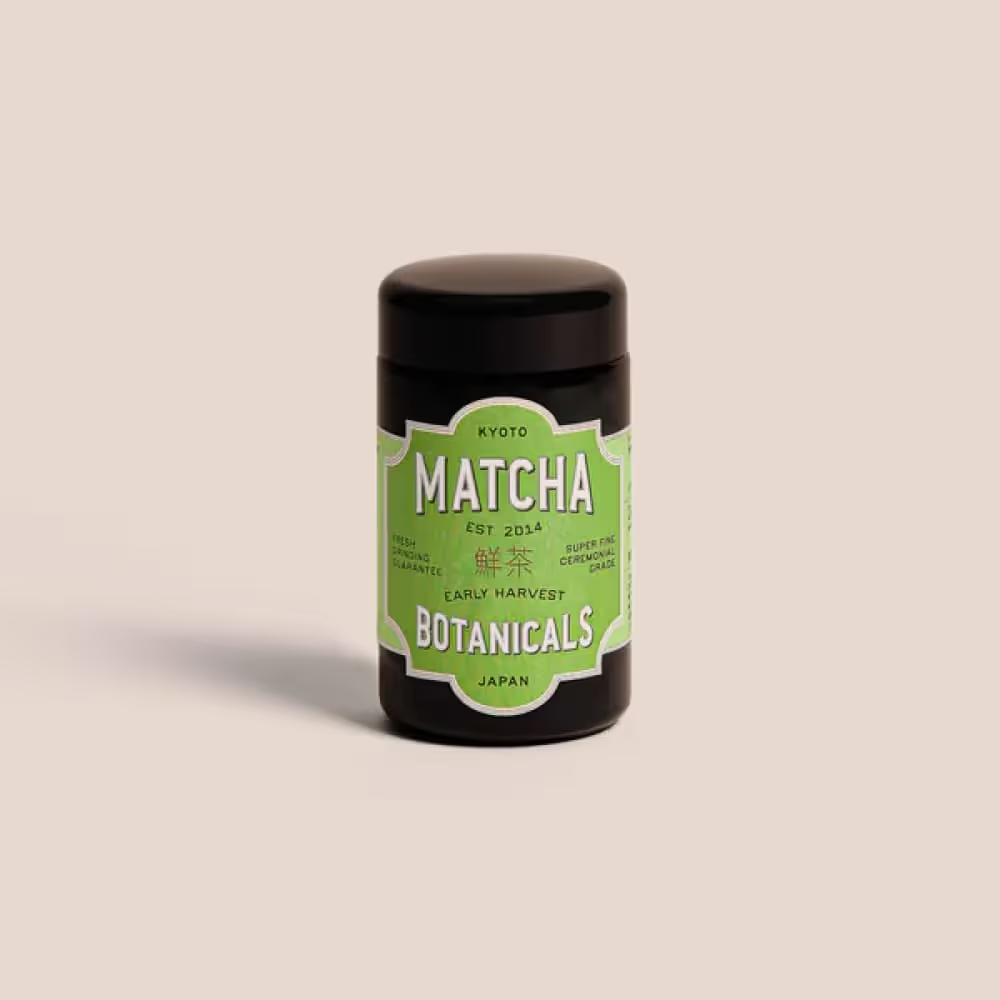
Matcha Botanicals publishes what almost no tea seller publishes: for every reference, the growing region, the cultivars, the number of shading days, the harvest month and the milling rate in grams per hour. The Early Harvest is a Yame blend of Okumidori, Yabukita and Saemidori shaded 22 days and milled at 38 g an hour, at $50.00 for 40 g. The Single Origin Vintage is a different tea entirely, single-cultivar Okumidori from Soraku, shaded 35 days and milled at 28 g an hour, at $54.00. The Gastronomy jar is a ceremonial leaf sold for cooking, $89.00 for 200 g. The jars are violet glass, chosen to block light.
Three things temper the enthusiasm. The prices sit at the top of the market, between $1.25 and $1.35 a gram on the ceremonial tins. The plantations are described as more than organic but no formal certificate or contaminant analysis is published. And the brand's Trustpilot profile stands at 2.4 out of 5 from 10 reviews, a small base but a poor one. On the plus side, delivery to the United States is documented: DHL Express from $19.99, free above $189.00.


In this full review we go through the real origin, the cultivars, the shading, the milling and the current US prices of Matcha Botanicals, tea by tea, based on the brand's official product pages and shipping policy.
Brand scores
Product scores
User experience
Shipping and customer service
Our analysis of Matcha Botanicals: the matchas under the microscope
This page is an analysis of the official Matcha Botanicals store and its product pages, not a tasting. Every price, cultivar, shading time and milling rate below was read on the store on the day of writing, on its US market, where prices are shown in dollars. Good news on availability first: the brand ships to the United States by DHL Express with a published rate table, so this is a real purchase route and not just a reference.
Second observation: the product sheets are exceptionally detailed for the tea trade. Each matcha states its growing region, its cultivars, the number of shading days, the harvest and even the milling speed in grams per hour, the number that separates a stone-ground matcha from an industrial one. That disclosure is what the brand is really selling, and it is also why two of its teas are so easy to confuse.
📌 Gastronomy Matcha 200 g: the recipe jar

The Gastronomy is the flagship jar and the odd one out in the catalog: a ceremonial-grade tea sold for cooking. The page gives Uji as the origin, hand-picked from the brand's own plantations, with Yabukita and Saemidori cultivars, a tiered 22-day shading, a first harvest in May and a terroir of clay layers over volcanic gravel. It is milled in the Kyoto workshop at about 50 g an hour and, according to the brand, freshly ground every two weeks.
Price: $89.00 for the 200 g jar on the US store, about $0.45 a gram, with a 5 g sample for anyone who wants to taste first. The stated character is intensely vegetal, built to hold up against milk, sugar and flour rather than to be drunk on its own. Two hundred grams is a real commitment for a product sold on freshness, so it suits daily bakers and latte drinkers rather than occasional ones.
📌 Early Harvest: the everyday ceremonial
The Early Harvest is the reference to start with, and the one most often described wrongly. Its page gives Yame as the growing region, not Uji, with processing in Uji in Kyoto Prefecture. Cultivars: Okumidori, Yabukita and Saemidori. Shading: 22 days. Harvest: the first one in May. Milling: 38 g an hour. The brand grades it Super Fine Ceremonial and describes it as made only from extra-young shoots, sweet and without bitterness.
Price: $50.00 for 40 g, with 5 g, 100 g and 200 g formats also listed. At about $1.25 a gram this is the everyday option of the range, meant for daily whisking. Matcha is a green tea and it carries caffeine, so the usual precautions apply: it is not for children, and anyone sensitive to caffeine or pregnant should count it alongside their coffee and tea.
📌 Single Origin Vintage: the connoisseur's cup
This is the reference the Early Harvest is confused with, and the two are genuinely different teas. The Single Origin Vintage comes from Soraku, uses Okumidori alone rather than a blend, is shaded 35 days by the shelf method rather than 22, and is milled far more slowly, at 28 g an hour. The brand describes it as vegetal and full-bodied, with pronounced umami and a creamy, abundant foam.
Price: $54.00 for 40 g, about $1.35 a gram. Longer shading and slower milling are exactly what a matcha drinker pays for at this level, so the four extra dollars over the Early Harvest buy a measurably different production, not just a different label. If you are buying one tin to drink straight, this is the one to compare against.
The verdict on format and dosing
The format logic is sound. Every matcha exists in 5 g, 40 g, 100 g and 200 g, so a sample costs a few dollars before a 40 g tin, and the 200 g jar only makes sense for heavy use. The jars deserve a word, since they are often described incorrectly: the brand's own page says they are violet glass, chosen for light protection, not black glass. The accessories follow the same house style, with a bamboo whisk at $22.00, a chashaku scoop at $11.00, a whisk stand at $17.00 and a Katakuchi bowl at $47.00.
On dosing, a ceremonial matcha is usually whisked at 1 to 2 g in 60 to 80 ml of water at around 80 degrees Celsius, while the Gastronomy is designed to be used more generously in a recipe. The freshness argument is the real constraint: with milling every two weeks and a stated guarantee of delivery within 30 days of grinding on the Hisei page, buying more than you will drink in a few months works against the very thing you are paying for.
Effectiveness and what to expect
Matcha is a food, not a supplement, and this review keeps it there. It is whole ground green tea leaf, so a cup carries more of the leaf's compounds, caffeine included, than an infusion of the same tea. Green tea has a long tradition of use, matcha specifically in the Japanese tea ceremony. Any claim beyond that belongs to whoever makes it, not to this page.
What Matcha Botanicals actually promises is sensory and agricultural: sweetness without bitterness on the Early Harvest, umami and creaminess on the Single Origin, a bright emerald colour, family farms with more than 300 years of practice, and shipments from the Uji plantation every two weeks. Those are brand-stated claims about taste and sourcing, and they are the right ones to judge a tea on. One gap is worth flagging: the pages describe the plantations as more than organic but do not publish a formal organic certificate or a downloadable contaminant analysis, so anyone who needs a lead, cadmium or pesticide report should ask for the batch certificate before ordering.
Who is Matcha Botanicals?
The legal seller is Matcha Botanicals GmbH, registered at Hungerbüelstrasse 3 in 8500 Frauenfeld, Switzerland, under VAT number CHE-481.068.848. That matters, because the brand is often filed as French on the strength of its matchabotanicals.fr domain: the store is Swiss-registered, with the sourcing and the workshop in Japan. No founder name or founding date is published on the site.
What it does publish is the supply chain. The matcha comes from family farms it describes as working the same land for more than 300 years, is processed and milled in its own workshop in Uji, Kyoto Prefecture, and is shipped from the plantation every two weeks. On outside feedback the picture is much thinner and should be said plainly: its Trustpilot profile shows a score of 2.4 out of 5 from only 10 reviews, a small sample but a poor one, and there is no independent rating platform with a larger volume for this brand.
📌 Key commitments
- Region, cultivars, shading days, harvest and milling rate published for every matcha
- Milling in the brand's own Uji workshop, freshly ground every two weeks
- Violet glass jars chosen to protect the powder from light
- Family farms described as working the same land for more than 300 years
- DHL Express delivery to the United States with a published rate table
Gastronomy Matcha against a standard culinary matcha
| Criterion |
Analyzed by TBS
Gastronomy Matcha by Matcha Botanicals
|
Standard culinary matcha
|
|---|---|---|
| Grade | ✅Ceremonial-grade leaf sold for cooking, first May harvest | ❌Culinary grade from later harvests |
| Origin detail | ✅Uji, Yabukita and Saemidori, 22-day tiered shading, clay and volcanic gravel | ❌Origin usually limited to "Japan" |
| Milling | ✅Own Kyoto workshop at about 50 g an hour, ground every two weeks | ❌Industrial milling, no grinding date |
| Packaging | ✅Violet glass jar chosen to block light | ❌Foil pouch |
| Price per gram | ❌$89.00 for 200 g, about $0.45 a gram | ✅$0.15 to $0.25 a gram |
| Ships to the United States | ✅Yes, DHL Express signed-for: $19.99, falling to free above $189.00 | ✅On US shelves and marketplaces |
The table explains the price gap and it does not hide it. Everything Matcha Botanicals adds is upstream: a ceremonial leaf instead of a late-harvest one, a documented terroir and cultivar, a slow mill with a grinding date, and a jar built to protect the powder. Against that, $0.45 a gram is two to three times a supermarket culinary matcha, which is the honest trade-off: this is a jar for someone whose matcha latte or matcha cake is the point of the recipe, not an ingredient among others.
The Matcha Botanicals range
The ceremonial line is the heart of the catalog, in 40 g with 5 g samples and larger formats: Hisei at $47.00, from Shizuoka and Kyushu with Saemidori and Tsuyuhikari and 20 to 25 days of shading; Tenkan Okumidori at $47.00; Early Harvest at $50.00; Single Origin Vintage at $54.00. Above them the vintage editions, Yumeno 40 g Limited Edition 2026 at $78.00 and Komorebi Imperial Vintage Edition 2026 at $101.00.
Around that core: the Gastronomy 200 g jar at $89.00, flavoured versions starting around $9.00 to $10.00 for Roasted, Sakura, Vanilla and Matcha Rose Latté, On The Go sample packs from $9.00, and the accessories, from the $9.00 bamboo spoon to the $153.00 premium gift box. It is a tea catalog with accessories, not a supplement range, and it should be judged as one.
Composition breakdown: what the matchas are actually made of
One ingredient, four variables
The ingredient list of every reference is the same single line: 100% green tea. What changes the cup is everything around it. The cultivar sets the aromatic base, Okumidori giving deeper umami and Saemidori the sweetness. Shading concentrates the leaf, and 35 days on the Single Origin against 22 on the Early Harvest is a large gap. The harvest date matters because only the first May picking gives the young shoots. And the milling rate, from 50 g an hour down to 28 g, decides how much heat the powder takes during grinding.
Reading the four teas side by side
Put plainly: the Early Harvest is a Yame blend of three cultivars, 22 days of shading, 38 g an hour, $50.00 for 40 g. The Single Origin Vintage is a Soraku single cultivar, 35 days, 28 g an hour, $54.00. Hisei blends Saemidori and Tsuyuhikari from Shizuoka and Kyushu on black crystalline schist and reddish yellow soils, 20 to 25 days, 50 g an hour, $47.00. The Gastronomy is Uji, Yabukita and Saemidori, 22 days, 50 g an hour, $89.00 for 200 g. Attributing the 35 days or the 28 g an hour to the Early Harvest, as is often done, describes a different tea.
Buying Matcha Botanicals from the United States
This is one of the few European stores on this site with a published US rate card, and it is a good one. Delivery is by DHL Express with signature and the cost falls as the basket grows: $19.99 below $39.00, $12.99 from $39.00, $9.99 from $69.00, $7.99 from $99.00, $4.99 from $129.00 and free from $189.00, with dispatch stated within one working day. Prices show in dollars once the US market is selected, so there is no currency guesswork.
The practical consequence is simple arithmetic: a single 40 g tin at $50.00 carries a $12.99 delivery charge, while two tins and a whisk clear $129.00 and drop it to $4.99. The code LMC is listed at 10% off eligible orders, which would take the $89.00 Gastronomy jar to about $80.10 and the $50.00 Early Harvest to about $45.00. Returns are accepted within 30 days on unused items in their original packaging, and authorisation has to be requested before shipping anything back, so an opened tin is not returnable.
Technical analysis and expert verdict
On the tea itself, this is a serious operation. Very few sellers publish the cultivar, the shading days, the harvest and the milling rate for every reference, and those four numbers are what determines a matcha's quality. The violet glass, the fortnightly milling, the stated 30-day window between grinding and delivery and the documented US rate card all point the same way: a brand that has thought about the product after it leaves Japan, not only before.
Three reservations. Price: $1.25 to $1.35 a gram on the ceremonial tins and $0.45 on the Gastronomy jar puts this at the top of the market. Documentation: the plantations are described as more than organic, but no formal organic certificate and no contaminant analysis are published, which is a gap for a product consumed leaf and all. Reputation: the Trustpilot profile sits at 2.4 out of 5, on a very small base of 10 reviews, and that is not something to skip past even if the sample is too small to conclude from. The code LMC gives 10% on eligible orders. For a reader who whisks matcha daily and wants to know what is in the bowl, the range earns its place; start with a 5 g sample rather than a 200 g jar.
The Matcha Botanicals flagship products
📌 Gastronomy Matcha 200 g
The flagship jar: a ceremonial-grade tea from Uji sold for cooking, Yabukita and Saemidori cultivars, 22-day tiered shading, first May harvest, milled in the brand's Kyoto workshop at about 50 g an hour and, it says, freshly ground every two weeks. $89.00 for 200 g on the US store, about $0.45 a gram, with a 5 g sample available first. Intensely vegetal, built to hold its own against milk, sugar and flour.
📌 Early Harvest Ceremonial Matcha
The everyday ceremonial and the better first purchase: Yame origin, Okumidori, Yabukita and Saemidori, 22 days of shading, first May harvest, 38 g an hour on the mill, graded Super Fine Ceremonial and described as sweet with no bitterness. $50.00 for 40 g, about $1.25 a gram, with 5 g, 100 g and 200 g also listed. Not to be confused with the Single Origin Vintage, a different tea at $54.00 with 35 days of shading and a 28 g an hour mill.
The promo code LMC is listed at 10% off eligible orders on the official Matcha Botanicals store, which brings the Gastronomy jar to about $80.10 and a 40 g Early Harvest to about $45.00.
Go further: browse the Matcha Botanicals brand page with the full product list, the Matcha Botanicals promo code LMC and the Gastronomy Matcha - Matcha Botanicals product sheet.
Our final verdict: should you buy from Matcha Botanicals?

The Best Supplements' editorial guidelines guarantee transparency and reliability: all our content is written by industry specialists and validated against 7 key criteria*, so every publication delivers quality information, promo codes, and reviews.
To support The Best Supplements, links on this site are affiliate links: we may earn a commission when you buy through these links, at no extra cost to you. By using the site you accept our terms of use and our editorial policy.

🎁 Want a -50% promo code you won't find anywhere else?
We negotiated an exclusive -50% promo code for you with a very well-known mushroom coffee brand. Interested? Subscribe and get your code straight to your inbox.
The 7 key criteria behind our reviews
Every piece of content published on The Best Supplements is carefully written by passionate experts, following a rigorous process. The Best Supplements is committed to providing information that is reliable, useful, and enjoyable to read.
Specialized, committed writers


Rigorous research behind every fact
Full transparency on sources

Focused on your real needs
Original, authentic content
Articles updated continuously

Compliance with standards and editorial ethics

Our favorite brand this month 🧡
Our pick of the month, one to try without hesitation.
IM8 Health