



PureTea Review: Is the 100% Ube Powder Worth Its Price?
PureTea is a French brand founded by two friends, Ben and Alex, built on single-ingredient powders: Philippine ube and Japanese ceremonial matcha, with no sugar, no milk and no flavoring. Here is our analysis of the composition, the prices in euros and the delivery terms, including what an American reader needs to check first.




Our verdict on PureTea in brief
The strength of this brand is the shortest ingredient list in its category. The Pure Ube Latte is 100% ube powder from the Philippines, 50 g net, with no milk powder, no sugar, no coloring and no caffeine, and the Pure Matcha Ceremony is 100% ceremonial matcha from organic farming, origin Japan, 50 g for about 30 cups. Everything a buyer needs is on the page: net weight, origin, dosing at 2 to 3 g per 100 ml, and a caffeine figure of about 70 mg per 2 g of matcha, which the brand publishes in its FAQ.
The reservations are elsewhere. No laboratory analysis, no farm and no cultivar are published, the marketing promises focus, stress relief and detoxification that no food label may claim, stock is unreliable with both matcha references unavailable at the time of writing, and the Trustpilot score sits at 3.7 out of 5 over 96 reviews. Above all, the store publishes delivery terms for France only, so an American order rests on a converted dollar price rather than on a published international rate.


In this full review we go through the published composition of the ube and matcha powders, the prices in euros, the caffeine figure the brand publishes, and the delivery and return terms of the official store.
Brand scores
Product scores
User experience
Shipping and customer service
Our analysis of PureTea: the powders under the microscope
This page analyzes the official PureTea store, product page by product page, with its ingredient lists, its preparation guidance and its delivery and return terms. It is not a tasting. PureTea is a French brand, based in Paris, whose store now runs in English as well as French and displays dollar prices to an American visitor, but whose published delivery terms cover France only, which is the point to settle before ordering from the United States.
The catalog has changed a lot since our first review. The two powders we cover here, ube and ceremonial matcha, now sit inside a much wider range of flavored ube, teas, infusions, bubble tea syrups and pearls, snacks and accessories. The good news is that both flagship powders keep a one-line ingredient list.
📌 Pure Ube Latte: one ingredient, purple
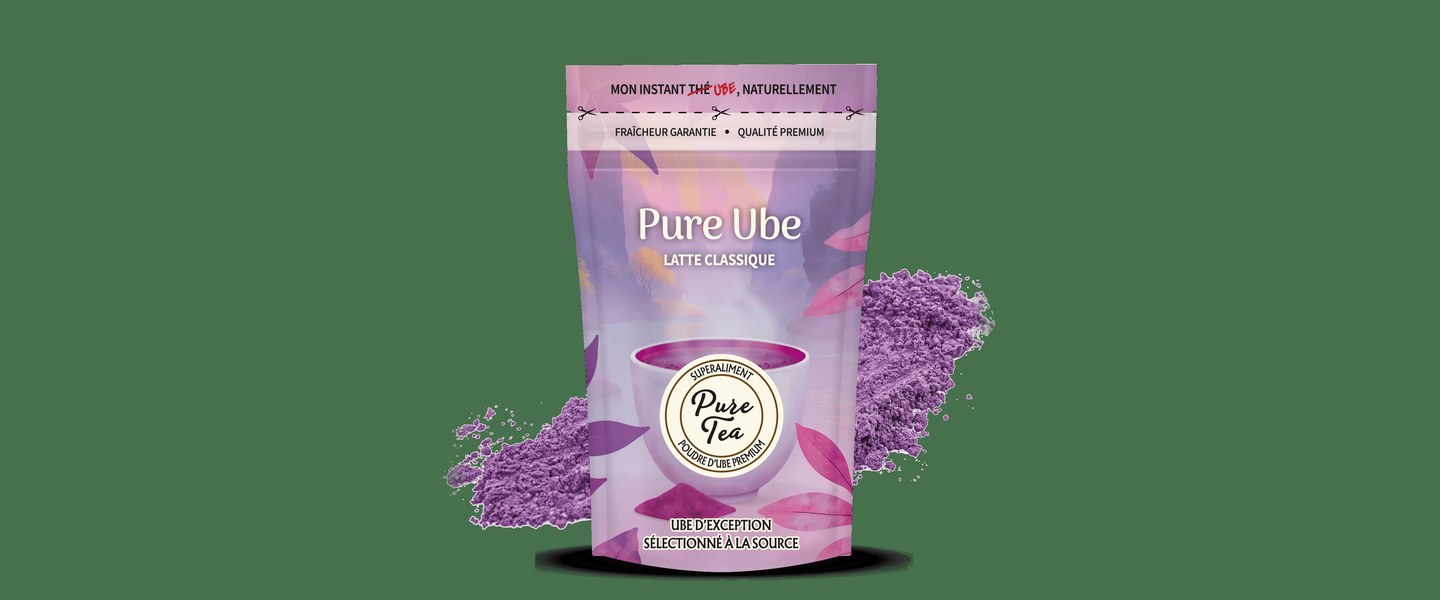
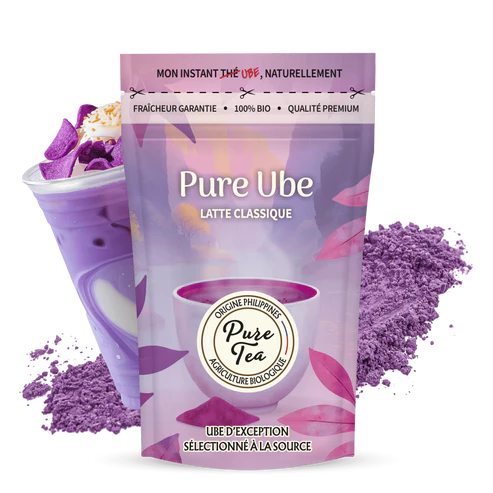
The composition could not be shorter: 100% ube powder, the purple yam of the Philippines, with the net weight stated at 50 grams per pouch and nothing else added. No milk powder, no sugar, no coloring, no flavoring and no caffeine, and the page carries milk-free, 100% plant-based and vegan badges. Preparation is 2 to 3 g per 100 ml at 70 degrees, roughly 25 cups per pouch, in water or in the milk of your choice, and the powder also works in baking.
Price: 12 euros for the 50 g pouch, 22 euros for 100 g, which the page states as 11 euros per sachet, and 41.80 euros for 200 g, at 10.45 euros a sachet. One warning printed on the page itself: the product is packed in a facility that handles nuts, milk and gluten, which matters for a severe allergy. The brand's own bullet points promise focus, gentle energy and stress reduction, and none of those are authorized claims for a yam powder; read it as an ingredient, not a supplement.
📌 Pure Matcha Ceremony: Japanese ceremonial grade
The matcha is just as short: 100% ceremonial matcha powder from organic farming, country of origin Japan, 50 grams net per pouch, for about 30 cups. The brand describes first harvest tencha leaves, steamed then slowly stone-ground between granite millstones, and sells it under the name Hisui. Price 27 euros for 50 g, 52 euros for 100 g, at 26 euros a sachet, and quantity discounts of about 1.19 dollars a unit from two pouches.
Two things to know. The store does publish a caffeine figure, contrary to what is often written about it: its own FAQ states about 70 mg of caffeine for 2 g of powder, which is why it advises against giving it to children under 12 and asks pregnant or breastfeeding customers to keep to one cup a day. And the pouch was out of stock on the official store at the time of writing, as was the vanilla matcha at 28 euros.
The verdict on format and dosing
The 50 g pouch is the discovery format across the range, and it is the right size for a first order on a powder that loses aroma with time and light. The store makes the arithmetic easy: about 25 cups of ube at 2 g, about 30 cups of matcha, with a stated price per sachet on the larger formats. On the ube, going from 50 g to 200 g takes the pouch from 12 euros to 10.45 euros equivalent, a modest saving that only makes sense for daily use.
Dosing guidance is precise on both: 2 to 3 g per 100 ml for the ube, 1 to 2 g sifted then whisked with water at 70 to 80 degrees for the matcha, milk added afterwards for a latte. That is more than most tea sellers publish, and the 70 mg of caffeine per 2 g gives a real reference point for anyone watching their intake.
Effectiveness and what to expect
Here the brand goes further than the label allows. The ube page promises focus, gentle energy, light digestion and stress reduction, and the matcha page speaks of natural detoxification, optimal mental clarity and maximum cellular protection. None of those are authorized claims, and no supporting study is cited on either page. What can be said is factual: matcha contains caffeine, about 70 mg per 2 g according to the brand, and L-theanine; ube is a starchy tuber whose purple color comes from anthocyanins.
These are foods to enjoy, and they should be judged on flavor, purity and freshness, which is exactly where a 100% single ingredient powder has an advantage over a sweetened latte mix. Anyone sensitive to caffeine, pregnant or breastfeeding should apply the brand's own restriction of one cup a day for the matcha.
Who is PureTea?
Behind PureTea there are Ben and Alex, two longtime friends who founded the brand in France, with an address in Paris, at 61 rue de Lyon, given on the returns page. The store states that its blends and recipes are made in France and works with producers in Japan, the Philippines and elsewhere. Orders placed before 3 p.m. from Monday to Friday are dispatched the same day, and every parcel is handed over against signature, with free reshipment announced in case of loss or theft.
On the customer side the picture is mixed. The Trustpilot profile, claimed since July 2025, shows 96 reviews for a score of 3.7 out of 5, with recent complaints about delivery and packaging. On the store's own widgets, the ube page displays 337 reviews and the matcha 48 reviews at 4.5 out of 5. The gap between the two is the usual one between reviews collected on the product and reviews about the service.
📌 Key commitments
- Single ingredient powders: 100% ube, 100% ceremonial matcha from organic farming
- Net weight and country of origin stated on each page, 50 g per discovery pouch
- Caffeine quantified in the FAQ: about 70 mg per 2 g of matcha
- Same day dispatch before 3 p.m. on weekdays, parcels handed over against signature
- Blends and recipes made in France, free French delivery from 39 euros
Pure Ube Latte against a standard ube latte mix
| Criteria |
Analyzed by TBS
Pure Ube Latte by PureTea
|
Standard ube latte mix
|
|---|---|---|
| Composition | ✅100% ube powder, nothing added | ❌Ube plus sugar, milk powder and flavoring |
| Sugar | ✅None added | ❌Frequently the first or second ingredient |
| Color | ✅Natural anthocyanins from the tuber | ❌Often a coloring agent |
| Published data | ✅Net weight 50 g, 2 to 3 g per 100 ml, about 25 cups | ❌Rarely a serving count |
| Price | ❌12 euros for 50 g, about 0.48 euros a cup | ✅Cheaper per pouch, but diluted with sugar |
| Ships to the United States | ❌The store publishes French delivery terms only | ✅Available from US retailers |
The table explains why this pouch is worth its price: you are buying the tuber and nothing else, which lets you decide the sweetness and the milk yourself, and gives the powder a second life in baking. The last two lines are the reservations, a price per cup above a supermarket mix and, for an American reader, delivery terms that only describe France.
The PureTea range
The ube family is now the heart of the catalog: Pure Ube Latte at 12 euros, Ube Coco at 12 euros, Ube Vanille, Ube Pistache and Ube Framboise at 13 euros, plus a discovery pack with a frother, a bamboo chashaku, 150 g of powder and a recipe booklet at 36 euros. On the matcha side, Pure Matcha Ceremony at 27 euros and Pure Matcha Vanille at 28 euros, both out of stock at the time of writing, and a Gaia Matcha at 22 euros.
Around them the store sells flavored lattes such as Tropical Strawberry, Banana Speculoos, Pumpkin Spice and Gingerbread at 11 to 13 euros, about twenty teas and infusions at 9 euros, bubble tea syrups and fruit pearls from 8 to 19 euros, Monka and Bitecone snacks at 5 to 6 euros, and accessories: bamboo whisk at 12 euros, chashaku at 4 euros, milk frother at 19 euros and a ceramic matcha kit at 33 euros. Stock is uneven, with a significant share of the snacks and several teas unavailable.
Composition breakdown: what the powders are actually made of
The ube, ingredient by ingredient
There is only one ingredient to break down, and that is the point: 100% ube powder, from the Philippines, with no additive, no sugar and no milk. The purple color comes from the anthocyanins naturally present in the tuber, which is also what the brand highlights, along with fibre and complex carbohydrates. The store publishes no nutrition table for this powder and no laboratory analysis, so the antioxidant and micronutrient claims stay at the level of the plant, not of the batch.
The flavored versions, vanilla, coconut, pistachio and raspberry, are a different matter: as soon as a flavor is added, the ingredient list is no longer a single line, and it is worth reading before assuming the same purity.
The matcha, from leaf to powder
Same structure: 100% ceremonial matcha powder from organic farming, origin Japan. The brand describes the classic process, shading the plants before harvest to raise L-theanine and chlorophyll, hand picking the young shoots, steaming to stop oxidation and grinding the tencha between granite millstones. The nutrition table given per 100 ml, for 3 g in 200 ml of water, is unsurprisingly light: 2 kcal, less than 0.1 g of fat, sugars and salt, 0.4 g of protein.
What is missing is the analytical layer. No catechin or L-theanine figure per batch, no farm or cultivar named, no pesticide or heavy metal report published, which is the usual gap in matcha and a fair question to ask support given the price.
Buying PureTea from the United States
PureTea publishes no international delivery terms. Its shipping policy names three French carriers only, Colissimo in 48 to 72 hours, Chronopost in 24 to 48 hours and Mondial Relay in 3 to 5 days, with dispatch within five business days, and its free delivery threshold, 39 euros, is stated for France. Its store does list the United States among the destinations it offers and displays converted dollar prices to an American visitor, 12 dollars for the ube pouch and 27 dollars for the matcha, but no rate and no lead time is published for a US address.
The return terms need the same caution. The refund page contains two contradictory paragraphs, one announcing a 14-day return window and the next a 30-day one, on top of the 14-day right of withdrawal it recognizes for the European Union. Perishable goods, which includes food, are listed among the items that cannot be returned, and returns must be requested first, by email, then sent to the Paris address. The LMC code is announced at 10% off eligible orders, which brings the ube pouch to about 10.80 euros and the matcha to about 24.30 euros.
Technical analysis and expert verdict
On composition, PureTea does the essential right. Two flagship powders with a single ingredient each, net weight and origin stated, precise preparation guidance, a caffeine figure published in the FAQ at about 70 mg per 2 g of matcha, a 50 g discovery format suited to products that age badly, same day dispatch and signature on delivery. For a purple latte, buying 100% ube rather than a sweetened mix is the right decision, and it is what justifies the 12 euros.
The limits are on proof and on service. No laboratory analysis is published for either powder, no farm or cultivar is named for the matcha, and the marketing claims, focus, stress, detoxification, cellular protection, go well beyond what a food label may say. Stock is unreliable, with both matcha references unavailable at the time of writing, the Trustpilot score sits at 3.7 out of 5 over 96 reviews, and the delivery terms only describe France. The LMC code takes 10% off eligible orders, which is worth confirming in the cart.
The PureTea flagship products
📌 Pure Ube Latte
The emblem of the brand: 100% ube powder from the Philippines, 50 g net per pouch, with no milk, no sugar, no coloring and no caffeine, labelled vegan and milk-free. Count 2 to 3 g per 100 ml at 70 degrees, about 25 cups per pouch, in water, in milk or in baking. Price 12 euros for 50 g, 22 euros for 100 g and 41.80 euros for 200 g. Packed in a facility handling nuts, milk and gluten.
📌 Pure Matcha Ceremony
The other flagship: 100% ceremonial matcha from organic farming, origin Japan, first harvest tencha stone-ground between granite millstones, 50 g for about 30 cups at 27 euros. The FAQ states about 70 mg of caffeine per 2 g, not recommended under 12 and limited to one cup a day during pregnancy or breastfeeding. It was out of stock on the official store at the time of writing.
The LMC code is announced at 10% off eligible orders on the official PureTea store, which brings the ube pouch to about 10.80 euros; check the discount line in the cart.
Go further: browse the PureTea brand page with the full product list, the PureTea promo code LMC and the Pure Ube Latte - PureTea product sheet.
Our final verdict: should you buy from PureTea?

The Best Supplements' editorial guidelines guarantee transparency and reliability: all our content is written by industry specialists and validated against 7 key criteria*, so every publication delivers quality information, promo codes, and reviews.
To support The Best Supplements, links on this site are affiliate links: we may earn a commission when you buy through these links, at no extra cost to you. By using the site you accept our terms of use and our editorial policy.


🎁 Want a -50% promo code you won't find anywhere else?
We negotiated an exclusive -50% promo code for you with a very well-known mushroom coffee brand. Interested? Subscribe and get your code straight to your inbox.
The 7 key criteria behind our reviews
Every piece of content published on The Best Supplements is carefully written by passionate experts, following a rigorous process. The Best Supplements is committed to providing information that is reliable, useful, and enjoyable to read.
Specialized, committed writers

Rigorous research behind every fact
Full transparency on sources
Focused on your real needs
Original, authentic content
Articles updated continuously
Compliance with standards and editorial ethics

Our favorite brand this month 🧡
Our pick of the month, one to try without hesitation.
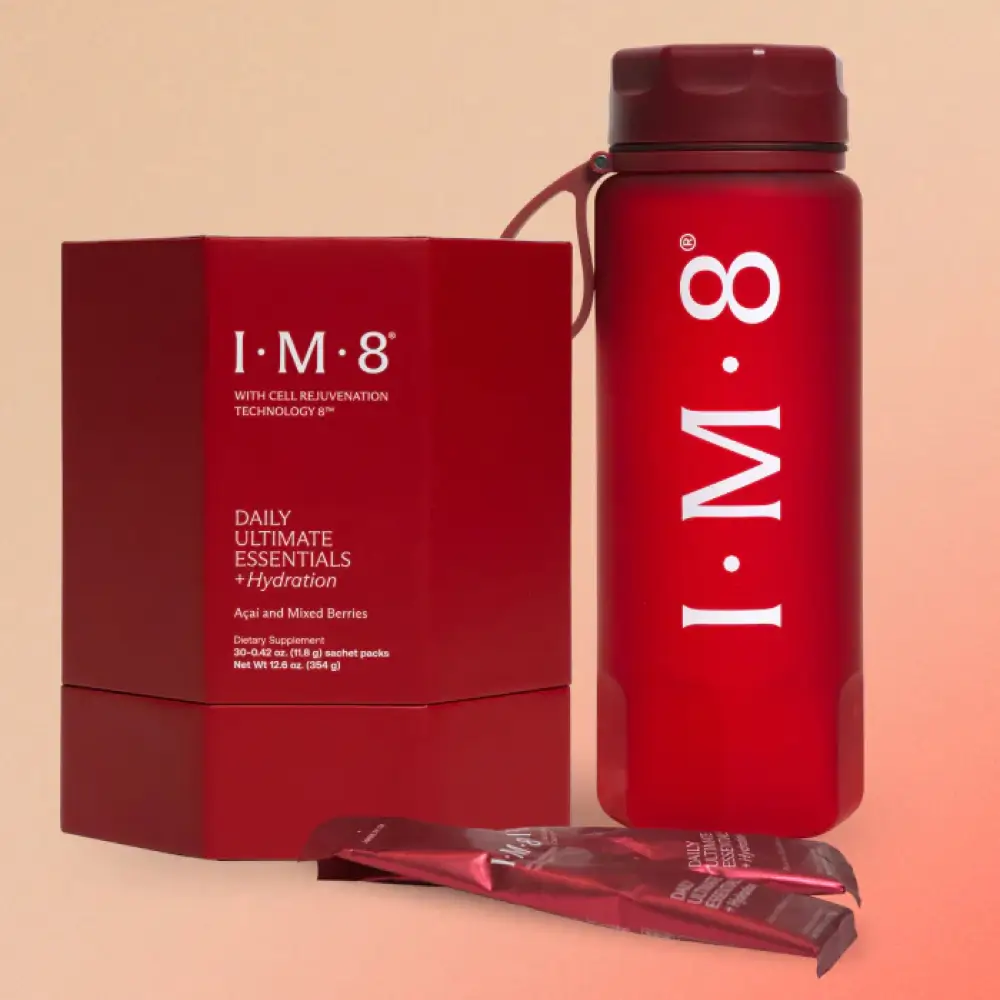
IM8 Health